CAS 1415-73-2 Aloin Powder for Sale
What is Aloin?
Aloin, also known as aloe-emodin, is a natural organic compound with the molecular formula C₂₁H₂₂O₉.
Physicochemical Properties
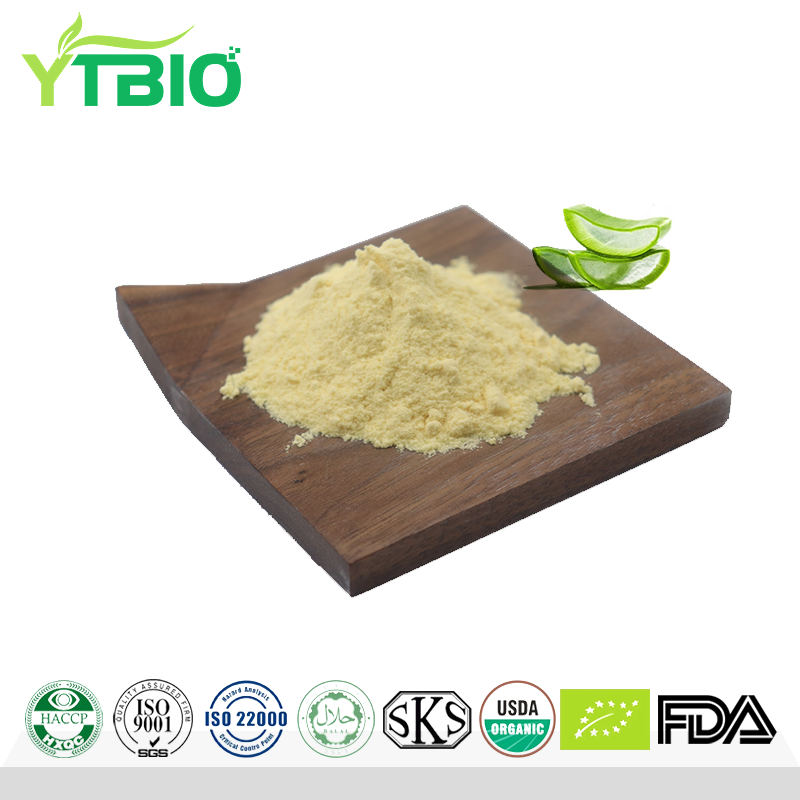
It crystallizes into yellow needle-like crystals in ethanol; it has good solubility, readily soluble in water and pyridine, and soluble in glacial acetic acid, formic acid, acetone, methyl acetate, and ethanol.
Plant Source
Primarily derived from monocotyledonous plants of the genus *Aloe* in the Liliaceae family, including closely related species such as *Aloe barbadensis*, *Aloe ferox*, and *Aloe vera*, obtained by concentrating and drying the leaf juice.
Physiological Activity
It possesses multiple pharmacological effects, mainly including laxative, depigmenting, tyrosinase inhibition, free radical scavenging, and antibacterial activities.
Food Safety and Dosage Guidelines
In vitro toxicological studies have shown that aloin can induce gene mutations in bacteria and mammalian cells; the food safety of anthraquinone laxatives, represented by aloin, remains controversial. my country's health food review clearly stipulates that the recommended daily intake of dried aloe vera products should not exceed 2g.
Storage Stability Conditions:
Solid state: Suitable storage environment: 15℃, protected from light;
Liquid state: Suitable stable environment: pH=1, strongly acidic conditions.
Extraction Method
A method for extracting aloin, characterized by the following steps:
(1) Peel aloe vera leaves, crush the aloe vera pulp, add 2-5 mL of 1% (v/v) methanol hydrochloride per gram of aloe vera pulp, homogenize to obtain a homogenate;
(2) Place the homogenate in an environment of 0-15℃, protected from light, and extract for 4-5 hours;
(3) Mix the extract with 60%-70% (v/v) ethanol at a ratio of 1:5-1:10, and perform ultrasonic extraction. The extraction conditions are: temperature 0-15℃, frequency 80 kHz, ultrasonic extraction for 30-120 min, extraction twice, and ethanol recovery;
(4) After ultrasonic extraction, centrifuge the extract at 0-15℃ for 20-30 min, collect the supernatant, add activated carbon, and decolorize;
(5) Pass the decolorized supernatant through a macroporous resin column at a flow rate of 0.5-1.5 BV/hr to separate impurities and obtain the aloin extract.
Application direction
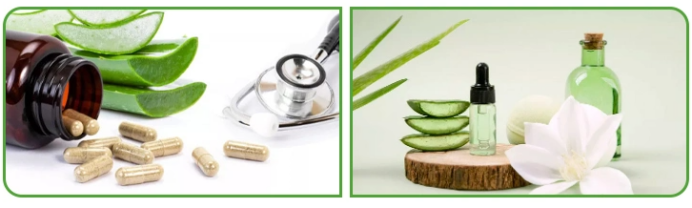
Aloe vera extract is a naturally occurring active compound found in aloe vera, possessing dual value in both healthcare and skincare.
In healthcare, aloe vera extract can purify the blood, soften blood vessels, effectively lower blood pressure and blood viscosity, promote blood circulation, and help prevent conditions such as arteriosclerosis and cerebral hemorrhage, playing a vital role in maintaining cardiovascular health.
In skincare, aloe vera extract can serve as a high-quality alternative to cosmetic ingredients, offering skincare, sun protection, anti-aging, and wound-healing benefits. It can also inhibit angiogenesis, promote melanin production, regulate transglutaminase activity, and be used to evaluate its bioactivity as a selective phosphodiesterase inhibitor.